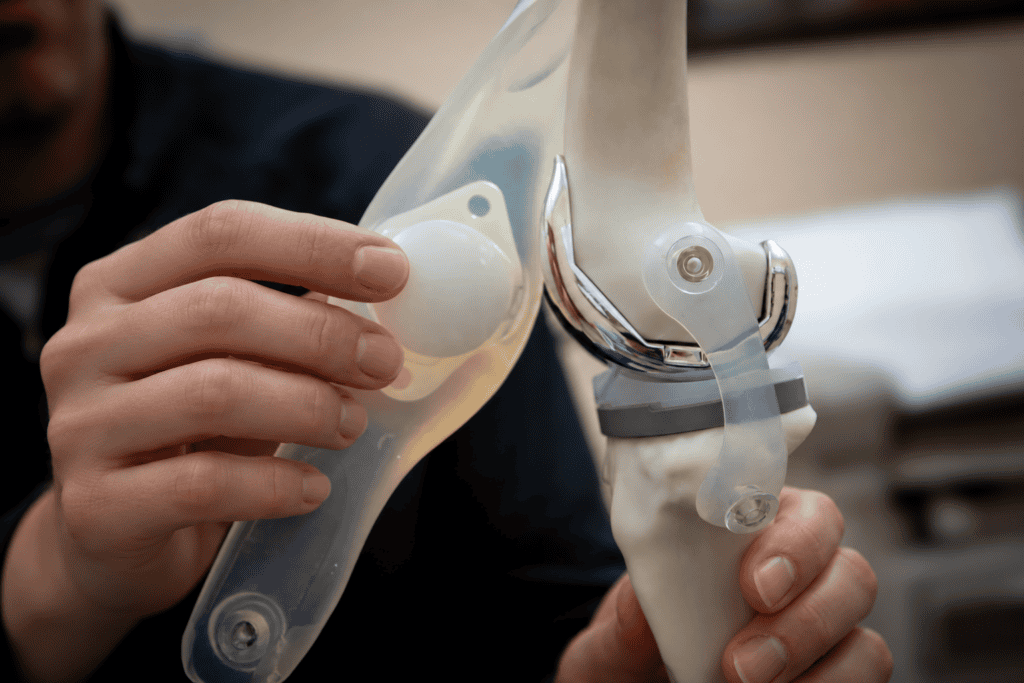
Physiotherapy after knee replacement helps patients bridge the gap between hospital discharge and daily life, but knowing what to expect at each stage makes an enormous difference to how you experience that process. At our Balgowlah and Cremorne clinics, the question we hear most in the first few days after surgery is some version of this: “Am I doing this right?” Patients arrive home with a single exercise sheet, a knee that feels like it belongs to someone else, and no clear sense of what normal recovery actually looks like. The anxiety is completely understandable. Total knee replacement is major surgery, and the gap between “here’s your discharge summary” and “here’s what the next twelve weeks will feel like” can be enormous.
What I want to do in this article is walk through the key physiotherapy milestones phase by phase, so you know what to aim for, what’s genuinely normal, and when it’s worth picking up the phone. One thing I’ve learnt from working with TKR patients for many years is that recovery unfolds in layers. There’s no single moment where you cross a finish line. Weeks zero to two are about survival. Weeks three to six are about rebuilding. Weeks seven to twelve are about reclaiming your life. Understanding that structure makes the whole process feel far less frightening.
What physiotherapy after knee replacement is actually doing in the first two weeks
Here’s something that surprises most patients: early post-op physiotherapy isn’t really about strength. Your quad muscle has just watched your knee get replaced, and it’s in a kind of protective shutdown. Swelling and pain commonly produce what’s known as arthrogenic muscle inhibition, which reduces quadriceps activation and means voluntary contraction may be limited until pain and effusion improve. Immobility, meanwhile, causes the joint capsule to stiffen rapidly. So the entire focus of the first two weeks is on two things: control swelling enough that movement is possible, and keep the quad from switching off entirely.
Controlling pain and swelling so movement is possible
The approach that works best here involves several strategies working together. Take your prescribed analgesia before exercise sessions, not after pain has already peaked, timing medication to support participation in rehab is a well-established principle of post-surgical recovery. Apply ice for fifteen to twenty minutes after activity to calm the inflammatory response. Elevate the leg above heart level when you’re resting. Use compression if your surgeon or physio has recommended it. The goal isn’t zero pain; that’s not realistic and honestly not even desirable at this stage. The goal is pain low enough that you can move safely and consistently.
The first exercises your physio will give you
The exercises in week one look deceptively simple, and that’s exactly the point. Ankle pumps, twenty repetitions every hour, keep blood circulating and reduce the risk of deep vein thrombosis. Quad sets, where you press the back of your knee gently into the bed and hold for three to ten seconds, are your most important early exercise because they directly fight that quad shutdown; aim for ten repetitions, four to five times daily. These aren’t glamorous exercises, but they are doing real, important work inside a joint that has just been through significant trauma. Heel slides, straight leg raises, and gluteal squeezes round out the programme, all done ten repetitions at a time, several times through the day.
Your first range-of-motion targets
Two numbers matter in the early weeks: zero degrees extension and ninety degrees flexion. Full extension, meaning your knee lies completely flat, is often the more urgent priority. A knee that rests with even a small bend will create gait problems further down the track because the joint never fully straightens during walking. Flexion to around eighty to ninety degrees by the end of week two is the standard benchmark, though I always remind patients that these are guides, not rigid pass-or-fail marks. Some knees get there in ten days. Others take a bit longer. Both can be completely normal.
Physiotherapy after knee replacement: milestones to track your progress
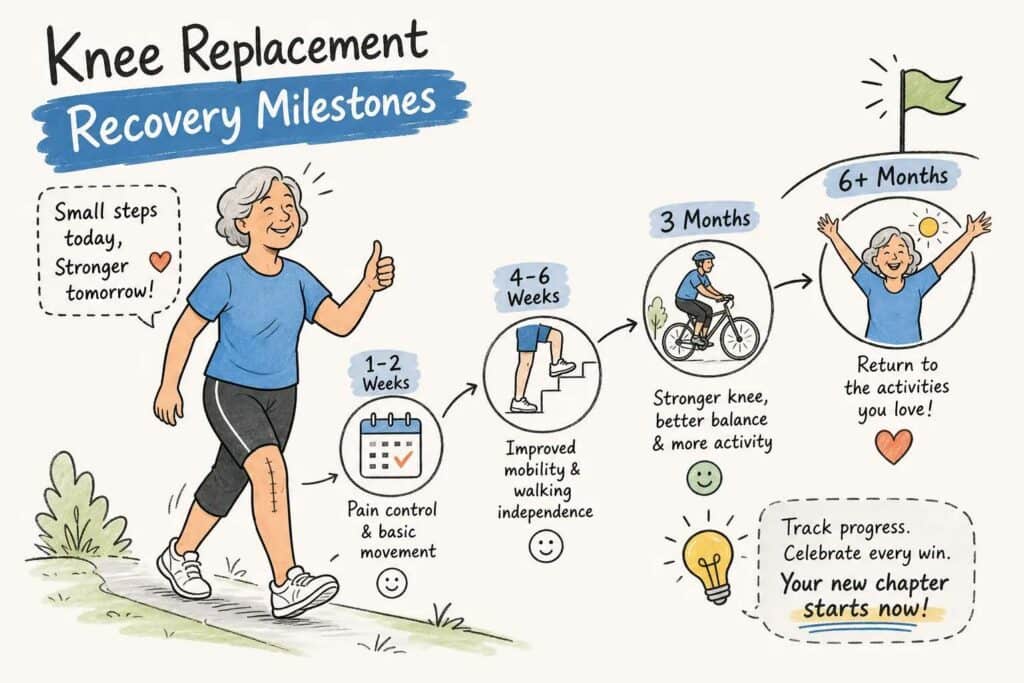
One of the most reassuring things I can tell a patient is that there is a well-established framework of what post-surgery knee physiotherapy recovery looks like across the first twelve weeks, with recognised benchmarks at two weeks, six weeks, and three months. Knowing this framework doesn’t mean your route will be identical to everyone else’s, but it does mean you have something to orient yourself against when you’re wondering whether a slow week means something is wrong.
Week 2: basic movement and getting upright safely
By the end of week two, most patients are walking short indoor distances with a frame or crutches, managing stairs one step at a time when needed, and sitting to stand with support. Flexion should be approaching eighty to ninety degrees, and extension should be close to zero. Swelling is still prominent at this stage. The quad is beginning to fire but isn’t reliable yet. The focus remains on swelling control and establishing those basic movement patterns safely.
Week 6: building independence
Week six represents a meaningful shift. Many patients transition to a walking stick or no aid at all around this point. Flexion typically reaches one hundred to one hundred and twenty degrees, and basic stair climbing with support is usually possible. Here’s something worth knowing: swelling can still fluctuate noticeably at six weeks, particularly after a more active day. That fluctuation is not a sign that something has gone wrong. It’s just the knee’s way of telling you it’s still healing, even as you’re doing more.
Week 12 and beyond: returning to daily life
By twelve weeks, flexion often reaches one hundred and twenty degrees or more. Walking distances increase steadily. The focus shifts toward gait quality, balance confidence, and returning to activities like driving, grocery shopping, and light exercise. This is honestly where post-op physiotherapy starts to feel worthwhile, because the functional gains begin stacking up in ways that matter to daily life. It’s not the end of recovery, but it’s where most patients genuinely start to feel like themselves again.
Progressing your strengthening and balance work (weeks 3, 12)
Once swelling is manageable and the quad is firing reliably, the job changes. Now the goal is to rebuild the strength and balance that protects the new joint during real-world activity. This phase feels different from the first two weeks: the exercises are harder, more purposeful, and occasionally uncomfortable in a productive way.
Moving from activation to loaded movement
In weeks three to six, the programme expands to include seated knee extensions, terminal knee extensions, hip abduction, short arc quads, and early stationary cycling. Stationary cycling is particularly valuable because it moves the joint through a useful arc of motion without placing impact load through the implant. Start with partial revolutions if full cycling isn’t yet comfortable, and progress from there. These exercises build on the quad activation work from the first fortnight, but now with more resistance and more range.
Exercises to do at home in this phase
You don’t need equipment for the most useful home exercises in this phase. Wall squats held for ten seconds build quad strength in a controlled, safe position. Mini-squats with good alignment train the joint through functional range. Step-ups on a low step replicate stair climbing and build single-leg strength progressively. Standing hip abduction targets the glutes, which play a major role in knee stability even though they’re not at the knee. The key principle is frequency over intensity: doing these exercises consistently through the day is more effective than one exhausting session.
Why balance and proprioception matter more than most patients expect
The original knee had a rich network of sensory receptors that told your nervous system exactly where the joint was in space at every moment. After replacement, that feedback system is disrupted. The new joint is strong and pain-free, but the nervous system needs time to recalibrate. Single-leg standing, slow weight shifts, and progressive balance challenges help rebuild that sensory awareness. Patients who include this work recover confidence on uneven surfaces and stairs far more quickly than those who focus only on strength exercises. It’s often the most overlooked part of home programmes.
When supervised physiotherapy after knee replacement changes the outcome
There’s nuance here that I think is worth being honest about. The evidence shows that for uncomplicated total knee replacement physiotherapy recovery, a well-structured home exercise programme can produce outcomes comparable to routine clinic-based physiotherapy. That’s genuinely good news for patients who are progressing well. But there are clear situations where supervised physiotherapy changes the outcome meaningfully.
Situations that call for hands-on assessment
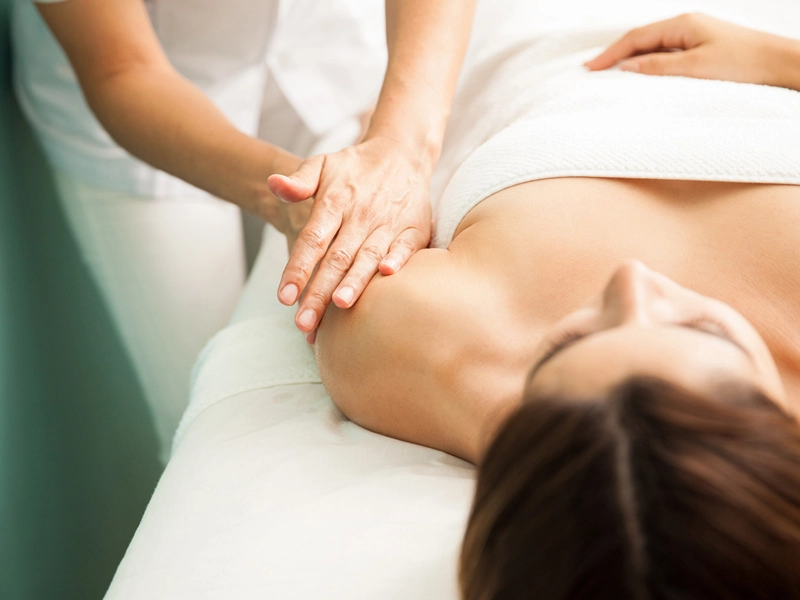
If you haven’t reached ninety degrees of flexion by the end of week two, it’s worth considering hands-on assessment and supervised physiotherapy, clinical guidance identifies this threshold as a point where more intensive input can make a real difference. If swelling keeps resetting your progress after every active day, a skilled physio can identify why and adjust the load accordingly. If fear of movement is causing you to guard the joint and avoid the exercises that would actually help you, graded exposure under supervision is far more effective than a printed sheet alone. These are the situations where the decision to see a physiotherapist regularly shifts from optional to genuinely important.
Reformer Pilates and targeted rehab at DX Physio
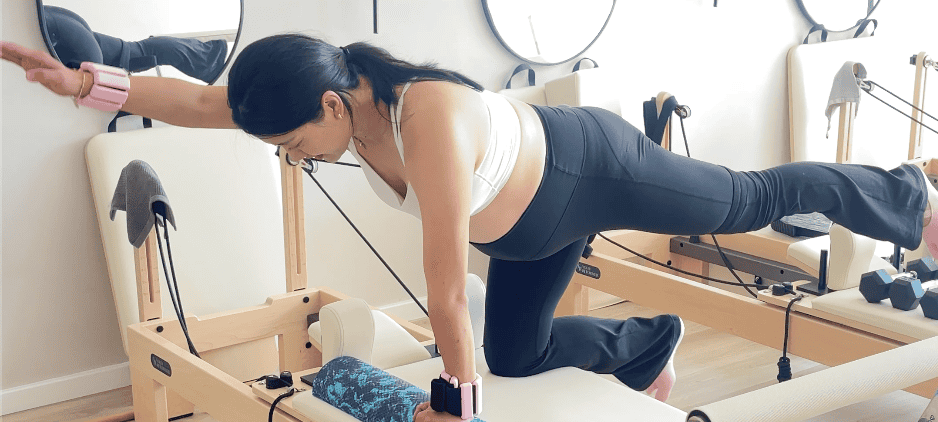
At our Balgowlah and Cremorne clinics, TKR rehabilitation goes beyond an exercise handout. Physio-led Reformer Pilates sessions can be a useful adjunct for selected patients in the middle recovery phase: the spring resistance system allows low-load, high-control strengthening work that targets quad strength, hip stability, and knee tracking without the impact or instability of gym-based exercises. It’s worth noting that high-quality evidence specifically for Reformer Pilates after total knee replacement is still limited, and it works best as one component within a broader, individually tailored plan. That broader plan includes a thorough musculoskeletal assessment to identify compensations like tight hip flexors, weak glutes, or altered gait patterns, addressing the whole picture rather than just the operated knee.
A patient scenario
The following is an illustrative case example; individual outcomes after total knee replacement vary widely. One patient came to our Balgowlah clinic at week six having stalled at eighty-five degrees of flexion with significant hip weakness on the operated side. Her home programme had been consistent, but the exercises weren’t challenging the right muscles. After a targeted assessment and a course of Reformer Pilates-based rehab focusing on hip stability and progressive knee loading, she reached one hundred and twenty degrees of flexion and was climbing stairs independently by week ten. She wasn’t a complicated case; she just needed the programme adjusted to match where she actually was, not where a generic sheet assumed she’d be. If you feel like your recovery has plateaued, get in touch with our team to book an initial assessment at Balgowlah or Cremorne.
Red flags, contraindications, and when to call your physio immediately
I want you to know these signs not to frighten you, but because catching them early genuinely matters. Most of what happens in TKR recovery is expected and manageable. But there are warning signs that require prompt attention, and being able to recognise them gives you confidence rather than anxiety.
Signs that need urgent medical review
Three categories need to be on your radar. The first is infection: watch for wound redness that’s spreading, increased warmth around the incision, any oozing or discharge, or pain that is worsening rather than gradually improving. The second is deep vein thrombosis: new calf pain or tenderness, swelling in one leg that is clearly greater than the other, or warmth or redness in the calf or thigh. If these symptoms are accompanied by chest pain or difficulty breathing, seek emergency care immediately as this may indicate a pulmonary embolism. The third is a mechanical problem: new clicking or clunking that wasn’t there before, a sense of instability or giving way paired with pain, or motion that is decreasing rather than improving. As a general rule, if pain lasts more than two hours after exercise, or if you notice new stiffness compared to the previous week, contact your physio or surgeon promptly.
Activities to avoid after knee replacement
Some activities create forces that the implant simply isn’t designed to handle, and avoiding them protects your investment in the surgery. Running, jumping, and high-impact aerobics are out. So are contact sports and any activity involving rapid twisting or pivoting, including tennis, squash, and skiing. Deep squats under load place excessive stress on the implant and should be avoided. These aren’t permanent restrictions on living fully; they’re specific activity categories where the mechanical risk outweighs the benefit for an implanted joint.
Recovery is a process, not a performance
Total knee replacement recovery isn’t linear, and confusion mid-way through is completely normal. There will be weeks where the knee feels worse than the week before, where swelling returns after a busy day, where the exercises that felt easy suddenly feel hard again. That’s not failure; that’s just how tissue heals.
It helps to keep the layered structure in mind when the middle weeks feel slow: the first two weeks are about getting the basics working and managing pain; weeks three to six shift toward rebuilding strength and independence; weeks seven to twelve focus on reclaiming function and confidence. Each phase builds on the one before it, even when the progress isn’t obvious day to day.
If you’re unsure whether your physiotherapy after knee replacement is on track, or you’ve reached a plateau that independent home exercise isn’t resolving, that’s exactly what we’re here for. Reach out to our team at DX Physio’s Balgowlah or Cremorne clinics to book an initial assessment and get a programme built around where you actually are in your recovery.
Frequently asked questions about physiotherapy after knee replacement
When should I see a physio after a total knee replacement?
Ideally, physiotherapy begins in hospital within the first day or two after surgery. Once you’re home, follow-up with a physio is recommended as soon as possible, and certainly within the first two weeks if you have any concerns about swelling, pain levels, or range of motion.
What range of motion should I aim for by week two?
The standard benchmark is zero degrees extension (a fully flat knee) and approximately eighty to ninety degrees of flexion by the end of week two. These are guides rather than strict pass-or-fail targets, and your physio will assess your individual progress in context.
Is it normal to still have swelling at six weeks?
Yes. Swelling commonly fluctuates at six weeks, particularly after more active days. Gradual improvement over time is the key indicator, a busier day causing a temporary increase is expected and not a sign that something has gone wrong.
How often should I do my exercises at home?
Frequency matters more than duration. Shorter sessions spread across the day are generally more effective than a single long session. For early exercises like quad sets and ankle pumps, several sessions through the day is the standard recommendation.
When can I return to driving after knee replacement?
Most people return to driving around six weeks post-surgery, though this depends on which leg was operated on, the type of vehicle, and your surgeon’s specific guidance. Your physio or surgeon should confirm when it’s safe for you individually.
What activities should I avoid after knee replacement?
High-impact activities including running, jumping, and contact sports are generally not recommended. Activities involving rapid twisting or pivoting, such as tennis, squash, and skiing, and deep squats under load should also be avoided to protect the implant.
What’s the difference between a home programme and clinic-based physiotherapy after TKR?
For uncomplicated recoveries, a well-structured home programme can achieve comparable outcomes to routine clinic visits. Supervised physiotherapy adds the most value when progress has stalled, swelling is difficult to manage, fear of movement is limiting exercise, or range of motion targets haven’t been met at key timepoints.
How long does full recovery take after a total knee replacement?
Most patients reach a functional level of recovery, able to walk independently, manage stairs, and return to daily activities, within three months. Full recovery, including optimal strength and confidence, often continues for six to twelve months post-surgery.