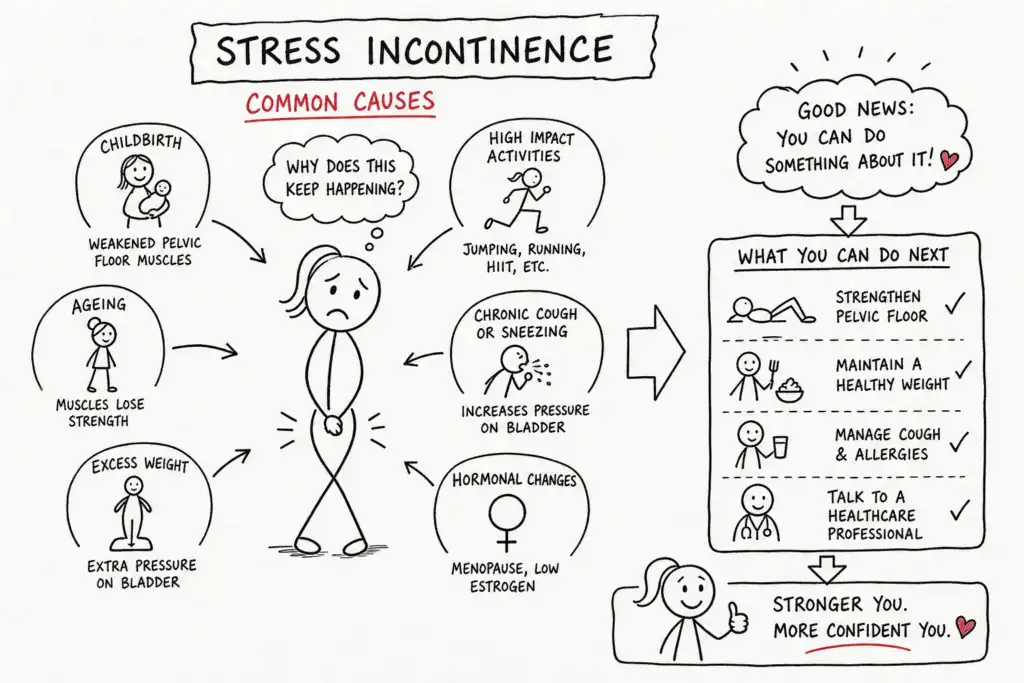
You sneeze in the supermarket queue and feel that familiar, unwelcome dampness. Or you break into a jog and notice leakage with every stride. Maybe it is a heavy lift at the gym, or simply laughing hard with friends. Whatever the trigger, the experience is stress incontinence, and it is far more common than most women realise. Australian data show urinary incontinence affects roughly 25 to 45% of adult women, with stress incontinence the predominant subtype in younger and middle-aged women, according to the Australian Institute of Health and Welfare. Understanding the causes for stress incontinence is the first step toward doing something about it.
This is not a condition to quietly manage with pads and avoidance. The causes are well understood, the treatments are backed by solid evidence, and the majority of women see meaningful improvement with the right approach. In this article, we walk through the mechanics behind stress incontinence, the risk factors that drive it, how a proper assessment works, and which treatments, from supervised pelvic floor training to surgery, actually deliver results. Our goal is to give you the information you need to take the next step, not reassure you with vague advice to “do your Kegels.”
Why the leak happens: the pressure-versus-closure equation
Stress incontinence has nothing to do with emotional stress. It occurs when a sudden rise in abdominal pressure, from coughing, sneezing, laughing, lifting, or exercise, exceeds the urethra’s ability to stay closed. Under normal conditions, three systems work together to keep the bladder outlet sealed: the pelvic floor muscles, the urethral sphincter complex, and the connective tissue supports, including the vaginal wall, endopelvic fascia, and pubourethral ligaments. When any of these systems are compromised, the equation tips the wrong way: bladder pressure wins over urethral closure pressure, and leakage follows.
The two main structural problems are urethral hypermobility and intrinsic sphincter deficiency (where the sphincter muscle cannot generate adequate closing force), and most women have some combination of both. Hypermobility occurs when weakened or damaged support structures allow the bladder neck and proximal urethra to descend during pressure spikes, moving into a position where they can no longer be compressed effectively. Intrinsic sphincter deficiency means the sphincter itself cannot generate enough resting tone or reflex contraction, even when its anatomical position is reasonably intact. Connective tissue damage from childbirth, surgery, or ageing compounds both problems by reducing the structural “backboard” that normally helps compress the urethra closed.
It is worth distinguishing stress incontinence from urgency urinary incontinence before going further. Urgency leakage is driven by sudden, uncontrollable bladder contractions and does not require a physical trigger like a cough or jump. Some women have both, a condition called mixed incontinence, which affects treatment choices. Getting the diagnosis right before starting a programme matters, which is exactly why assessment comes before treatment.
Causes for stress incontinence: pregnancy, menopause, and lifestyle factors
Pregnancy and vaginal delivery sit at the top of the risk list. Pregnancy loads the pelvic floor with sustained downward pressure for months and stretches connective tissue supports. Vaginal birth can directly injure the levator ani muscles, the pudendal nerve, and the urethral sphincter, with risk rising sharply in prolonged labour, forceps or vacuum-assisted delivery, and multiple births. Approximately one in three women report stress leakage five years after a first vaginal delivery. The damage is often subtle and cumulative, which is why symptoms can surface years after the birth itself.
Menopause adds a separate layer of vulnerability. Declining oestrogen thins the urethral epithelium and reduces the elasticity of the submucosal tissue and periurethral vascular plexus, the vascular cushion that normally bulks the urethral wall and contributes meaningfully to its resting closure pressure. When that cushion diminishes, urethral resistance drops. In clinical practice, postmenopausal women typically present with lower maximal urethral closure pressures than premenopausal women, which is why stress incontinence often becomes more noticeable during the perimenopausal years, even in women who had no symptoms after childbirth.
Several lifestyle and health factors accelerate risk across any life stage. Persistent excess abdominal weight creates ongoing pressure on the bladder and its supports, a dose-related effect that responds meaningfully to weight loss. Chronic coughing from asthma, smoking, or respiratory illness repeatedly spikes pelvic pressure and can fatigue or stretch support structures over time. Regular straining with constipation works through the same mechanism. Previous pelvic surgery, including hysterectomy, can alter fascial attachments and sphincter function. Smoking contributes partly through its direct association with chronic cough, and possibly through connective tissue effects as well.
Getting an accurate picture: assessment for causes for stress incontinence
A proper evaluation starts with a thorough clinical history. A physiotherapist or GP will ask when leakage occurs, how much, what triggers it, and how it affects daily life. They will also ask about urgency, frequency, bowel habits, pelvic pain, prior births or surgeries, and any neurological symptoms. A three-day bladder diary records fluid intake, voiding times, and leakage episodes; patterns that seem random often become clear when mapped this way. A cough stress test, where the clinician observes for leakage with the bladder reasonably full, directly confirms the diagnosis. Urinalysis rules out infection, blood, or other contributors that can mimic or worsen symptoms.
A pelvic floor physiotherapy assessment goes considerably further than a standard GP visit. The physiotherapist evaluates pelvic floor muscle strength, endurance, tone, coordination, and the ability to relax through a gloved internal examination. The assessment also identifies pelvic organ prolapse, scar tissue, pain points, and functional movement patterns that affect load on the pelvic floor during everyday activities. DX Physio’s Balgowlah and Cremorne clinics deliver personalised treatment plans. Urodynamics or specialist referral are reserved for complex cases where the diagnosis is unclear, prior treatments have failed, or surgery is being planned.
Conservative treatments with real evidence behind them
Supervised pelvic floor muscle training is the most evidence-backed first-line treatment for stress incontinence, and the emphasis on “supervised” is important. A typical protocol involves 8 to 12 strong contractions per session, held for 6 to 8 seconds each, across at least three sets daily, progressively incorporating contractions during coughing, lifting, and exercise. Australian guidance from the RACGP recommends continuing this programme for at least three months before judging its effectiveness. A Cochrane review on pelvic floor muscle training for urinary incontinence found that approximately 40% of women achieve complete continence with well-supervised training, while up to 90% report meaningful improvement in some higher-intensity programmes. Supervised programmes consistently outperform self-directed exercise for these outcomes, which is why regular physiotherapy review, technique correction, and progressive loading over time make the real difference.
Pilates as a complement to pelvic floor training
Clinical Pilates and Reformer Pilates, led by a pelvic health physiotherapist, complement pelvic floor muscle training by rebuilding deeper core stability and motor control around the pelvis. The evidence is clear that Pilates should not replace targeted pelvic floor training for stress incontinence, but as an adjunct it supports strength, movement confidence, and recovery into active life. DX Physio offers physio-led Reformer Pilates classes at Balgowlah and Cremorne to support rehabilitation and rebuilding strength.
Lifestyle modifications
Lifestyle modifications carry genuine clinical weight alongside these interventions. Weight loss of even 5 to 10% of body weight reduces leakage episodes in women with obesity, a finding supported by the PRIDE trial, a randomised controlled trial examining weight loss and urinary incontinence outcomes. Managing chronic constipation removes a significant ongoing source of pelvic floor strain. Continence pessaries, removable vaginal devices that mechanically support the bladder neck during activity, offer an immediately reversible option for women who need relief during sport or exercise while rehabilitation progresses. Bladder training, which gradually extends the time between voids and introduces urge suppression strategies, is most useful for women who also have urgency symptoms alongside their stress leakage.
When conservative care isn’t enough: medical and surgical options
For women with persistent, bothersome leakage after a genuine three to six month conservative programme, surgical referral is a reasonable next step. Mid-urethral sling procedures, which involve placing a small strip of mesh beneath the urethra, carry success rates of approximately 85 to 90% at one year according to systematic reviews of surgical outcomes for female stress incontinence, and they remain the most commonly performed surgical option in this population. Burch colposuspension, which sutures tissue beside the bladder neck to the pelvic ligaments, and autologous fascial pubovaginal slings achieve comparable long-term outcomes with different recovery profiles and no mesh. Urethral bulking injections offer a less invasive alternative, particularly for mild leakage or women who want to avoid major surgery, though results are generally less durable and repeat procedures are often needed.
All surgical decisions carry specific trade-offs. Mesh-related risks including erosion, dyspareunia, and pelvic pain require informed discussion. Recovery times vary between procedures, and the possibility of revision surgery is a real consideration in shared decision-making. These are conversations that belong in a specialist urology or urogynaecology setting, ideally after a pelvic health physiotherapist has documented what conservative care was attempted and for how long.
There are also situations that require prompt GP review rather than waiting for a physiotherapy appointment. Blood in the urine, recurrent urinary tract infections, pelvic pain, difficulty emptying the bladder, or any new neurological symptoms warrant medical assessment first. For everyone else, the path to surgery runs through conservative care, not around it.
Understanding the causes for stress incontinence is where real progress starts
The most common causes for stress incontinence, childbirth, menopause, obesity, and chronic pelvic pressure, are well understood, and the majority of women respond to conservative care when it is properly directed. Targeted pelvic floor training, lifestyle modification, and physio-led Pilates, delivered consistently and with sound technique, can make a significant and lasting difference. Surgery is a legitimate and effective option for women who need it, but it works best as an informed choice after conservative treatment has been genuinely trialled.
A full assessment covers muscle function, contributing factors, and a treatment approach tailored to your history, not a generic protocol. Get in touch with our team to make an appointment.